Making the
Little Range.
How making things for my children led to a wooden play kitchen, and the question that kept coming up: if there are already plenty of good ones, what would make another one worth making?
It started with their rooms.
I got into woodworking by making things for my children.
It started with my daughter’s room. I wanted it to feel unmistakably hers, which meant choosing the colours, shelving and smaller details instead of finding something ready-made that was close enough. Then came rooms and bunks for my two sons, and somewhere along the way I realised I liked making this stuff as much as they liked having it.
Part of the appeal was being able to take a child’s thing seriously. I could think about the joins, the edges, the proportions and the way it would sit in the room, then add the colour and character that made it belong to them.
When I started thinking about what to make next, I kept coming back to a play kitchen. There are already a lot of them, and some are very good. So why make another one?
Why another kitchen?
I didn’t have a good answer at first. Wanting to make something isn’t quite enough reason to put another product into the world.
I knew what I didn’t want: a miniature version of a contemporary fitted kitchen, loaded with features and trying to reproduce every appliance an adult might have.
I wanted something simpler. Something with enough character to hold its own in a room, but enough restraint for the child to decide what sort of place it was.
The shape started to click when I stopped looking at modern kitchens and looked backwards instead.
Nan’s kitchen had a bit of character.
I kept coming back to old freestanding cookers. Rounded corners, chunky knobs, enamel colours, a tea towel over the handle. One object could give an otherwise ordinary kitchen a lot of character.
Photos: Taylor Thompson & Charlotte May / Pexels.
That felt more interesting to me than shrinking a modern fitted kitchen down to child size. A freestanding cooker already has the proportions of a single piece of furniture. Give it a cupboard, a worktop and a few things to turn, and it becomes a place for the game without having to explain the game.
That became the starting point for the Little Range: lower and more self-contained, with the shape of an old cooker, not a miniature kitchen wall. It borrows the softened corners, handles, row of knobs and small raised back from those shapes without being a replica of any particular appliance.
Photo: Magda Ehlers / Pexels.
The colours came from the same place. Blood red, bone, fern and butter feel at home on an old enamel cooker, but they don’t need to stay in the past. Keeping the stronger colour on the handles, knobs and trim gives the kitchen contrast without painting the whole thing red or green.
I’m less drawn to the all-beige look. Children’s furniture can take a bit of colour. The Original is cream and black, and Good Wood leaves the grain visible, so restraint still has a place here. I just don’t think neutral has to be the default.
The retro shapes suit these combinations. I’m not especially interested in whether they’re in fashion; I’d like to still enjoy looking at them in a few years.
Have a look at the four colourways
The old cooker gave me a shape and a mood. It didn’t answer the question of why another one.
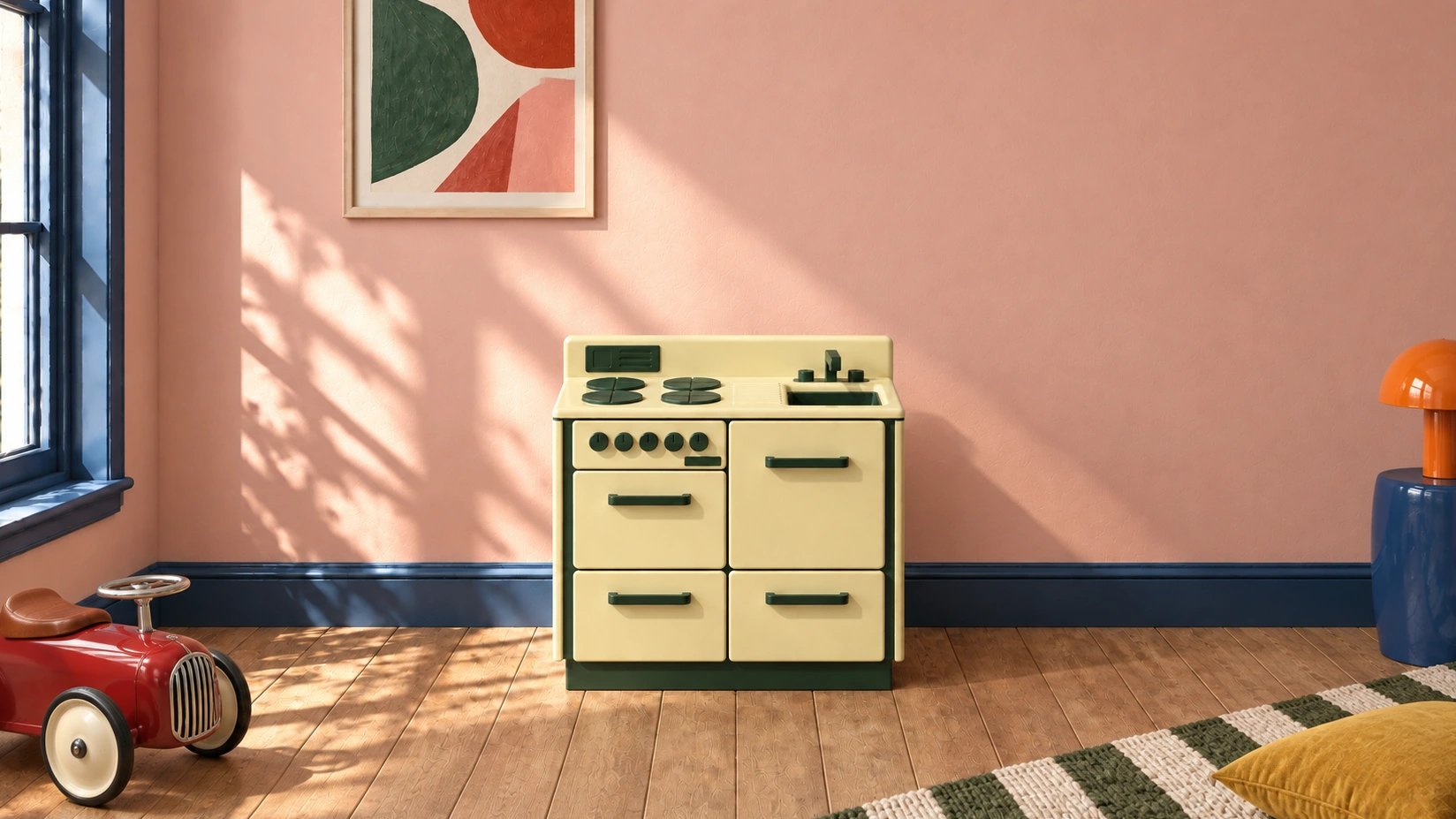 Lemon Twist
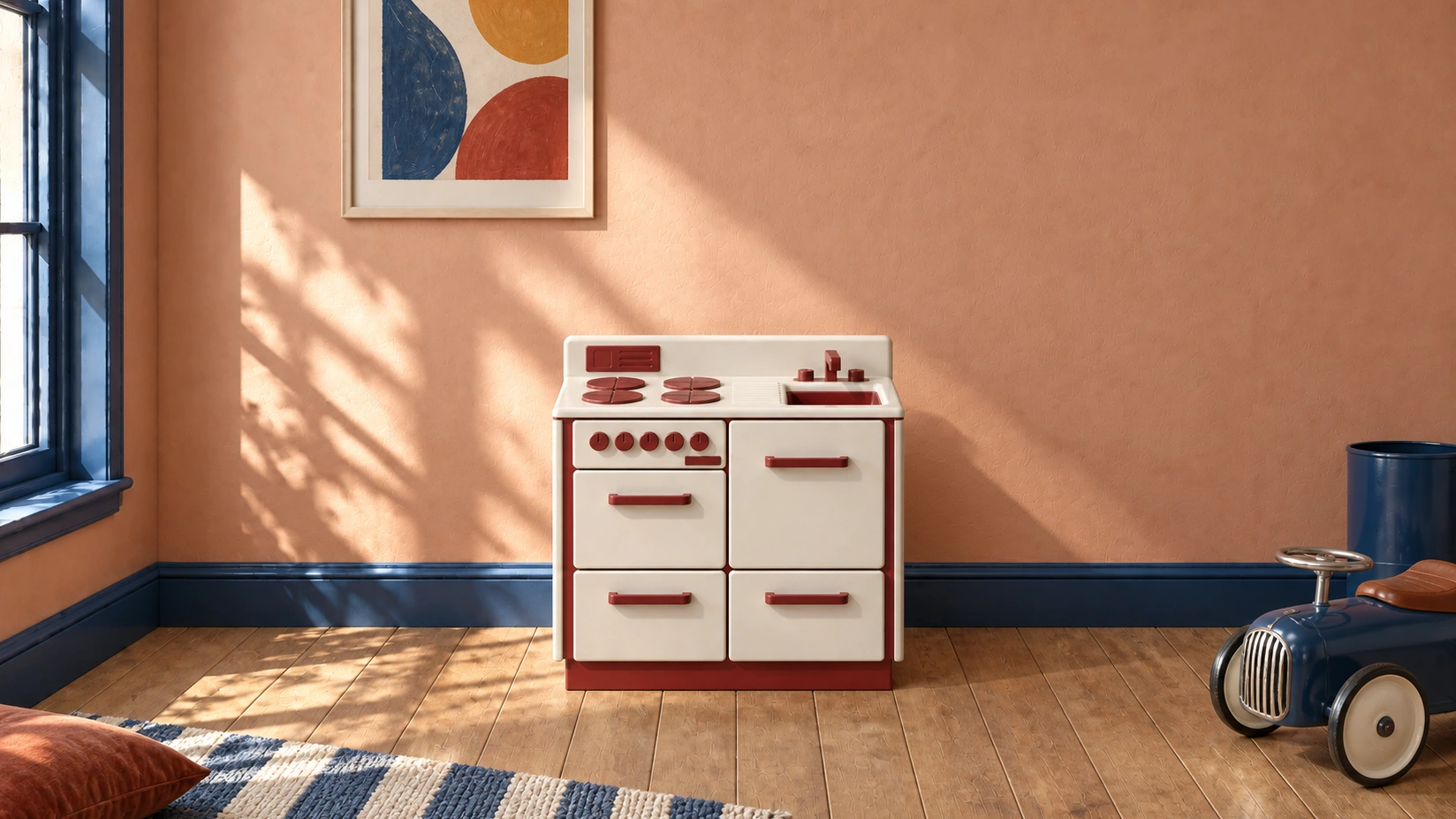 Cherry on Top
IKEA, Milton & Goose,
and Le Toy Van.
So I looked at what was already out there, to work out where there was room to do something different.
I haven’t tested these kitchens side by side. The notes below are based on the manufacturers’ published specifications, dimensions and materials, checked in September 2026; the linked pages have current details and availability. Each one forced a different decision about ours.
IKEA DUKTIG
The DUKTIG combines birch plywood and fibreboard, with a removable plastic sink, light-up hob and three adjustable leg positions.
If someone can buy a good wooden play kitchen from IKEA for much less, why should ours exist?
We’re not going to compete with IKEA on price, and we’re not trying to. Small batches, Australian hoop pine plywood, a two-pack finish and hand assembly in Sydney cost more. So the reason had to be in the object: the cooker shape, the exposed ply, the colour and the fittings.
IKEA’s DUKTIG detailsMilton & Goose Essential
Milton & Goose makes its Essential kitchen in the USA using Baltic birch plywood and solid North American maple. It has turning knobs and opening doors, and its finishes include Dusty Rose and Light Sage as well as neutrals.
Milton & Goose gave me a different answer. Their kitchens helped show that children’s furniture could be treated with the same seriousness as furniture for the rest of the house. I like the attention they give to timber, colour and construction.
That idea matters to the Little Range too, but I wanted to take it somewhere different: Australian hoop pine, a lower shape borrowed from an old cooker, and small batches made here in Sydney.
That settled how seriously I wanted to take the object. The next question was how much the object should tell the child what to do with it.
Milton & Goose’s Essential detailsLe Toy Van Oxford
Le Toy Van’s Oxford pairs royal blue with copper-effect details. It includes an oven, hob, sink, microwave and utensils, and its product page lists FSC-certified wood.
I like their willingness to use colour. For my taste, there’s more going on in the Oxford than I wanted in ours. The microwave and fittings above the worktop make it feel like a whole fitted kitchen.
I wanted the Little Range to stop earlier. A cooker, a cupboard, knobs to turn and room to put things. Enough to start the game, without deciding too much of it in advance.
A child can make breakfast there, run a café, sell completely inedible soup, put every toy they own into the cupboard, or decide it isn’t a kitchen at all.
The less specific the object is, the more specific the game can become.
Le Toy Van’s Oxford details“This is the version
I wanted to make.”
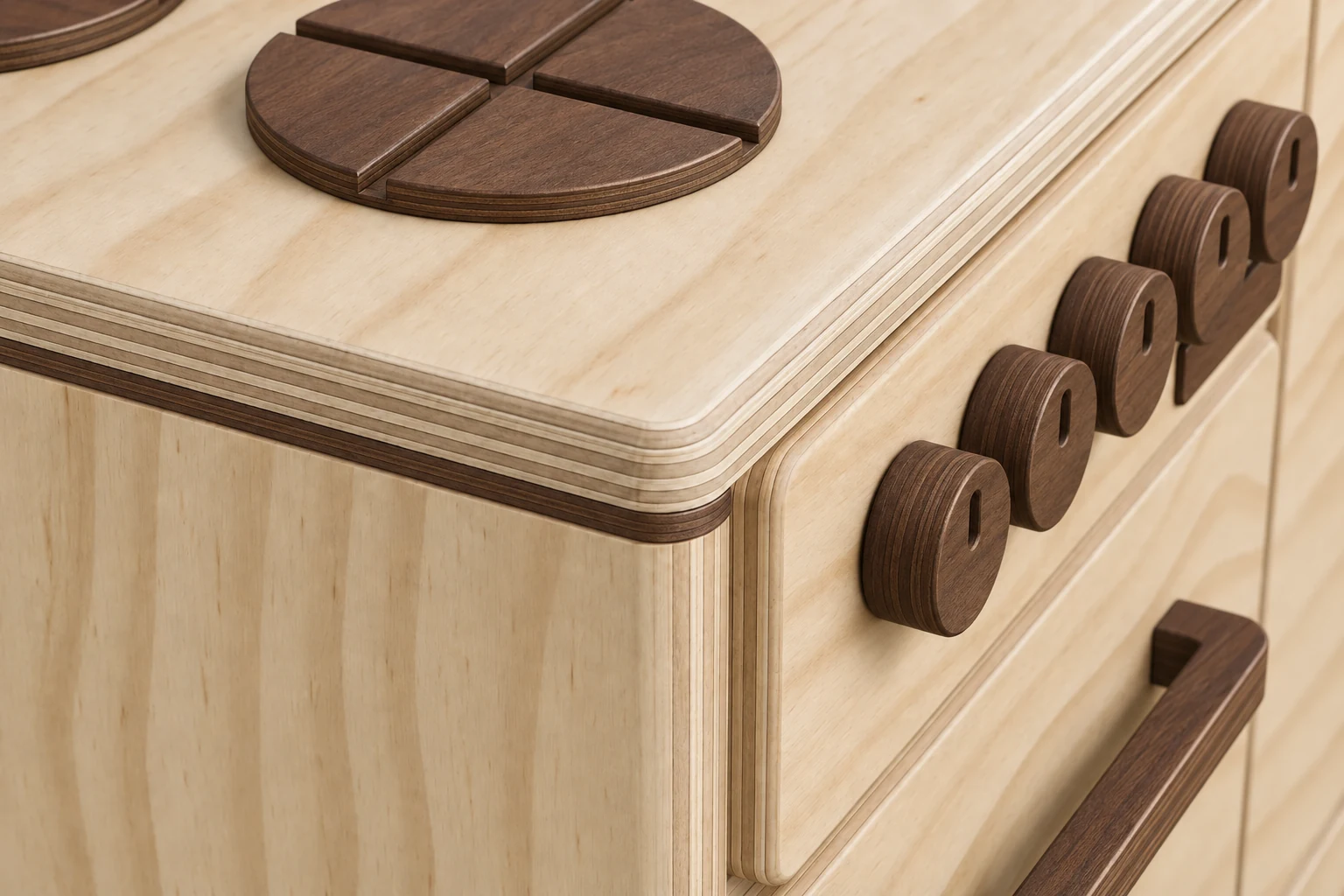
Artist’s impression.
Made here.
The Little Range is being made in small batches here in Sydney, using Australian hoop pine plywood. Keeping the work close means I can stay involved in each kitchen and take time over the details.
I got into this by making things with my hands, and I wanted the business to leave room for that.
Standing in front of a piece, you notice how an edge feels, where two panels meet and whether a fixing shows. I’ve chosen furniture fittings that tuck out of sight. I don’t want a row of screw heads across the sides to be the first thing you see.
Thinking about how it lasts.
I want this kitchen to be passed on. I’m not calling it an heirloom before it has earned the word, but I can design for a long life now: good materials, durable finishes and a construction that can come apart and go back together.
We’re using Australian hoop pine marine-grade plywood, with rounded edges and corners. The painted versions will have a two-pack finish, and Good Wood will show the timber. I’ll share the coating details and care instructions before orders open.
The kitchen is designed to travel flat-packed and go together with a hex driver, with no glue needed during assembly. Furniture connectors and threaded inserts will let it come apart without repeatedly driving screws into the timber. That will matter if it needs to be packed for a move or stored between children.
None of that guarantees where a kitchen will be in twenty years. It does mean I can avoid designing an obvious end into it now.
There are more construction details on the main page. I’ll add to those as the design is finalised.
Keeping it simple.
There’s one more design decision, and it may be the most important one: where to stop.
Some of the Little Range is for the adults who live with it: the timber, the construction and the colours, which probably matter more to us than to a three-year-old making toast.
For the child, the job is different. There need to be knobs to turn, cupboards to open, somewhere to put things and enough clues to get a game started. After that, I’d rather get out of the way.
That’s the balance: make the object carefully enough for the adults to value it, without making it so designed that there’s nothing left for the child to invent.
Then it’s theirs.
My daughter’s room started all of this because I wanted to make something that felt like hers.
I can choose the timber, the colours, the height, the curves, the finish and the way the pieces go together. I can decide what not to add.
Then a child stands in front of it and the design stops being mine.
Breakfast, café, shop, potion laboratory. Whatever happens next is their part.
That’s what makes another play kitchen worth making.
A few useful answers.
What should I look for in a wooden play kitchen?
I’d measure the room first, then the child: overall size and benchtop height decide whether it suits either. Then the unglamorous things: assembly instructions, age guidance, and whether it needs anchoring. After that it’s what you care about most: price, materials, features, where it’s made, or how it looks in your home. Different kitchens make different trade-offs.
Is the Little Range available in Australia?
Yes, and to begin with only in Australia. We’re making the Little Range here in Sydney for an Autumn 2027 launch, and because it’s a large, heavy parcel we’ll be delivering to Australian addresses only when orders open. The waitlist is open now, wherever you are, and if you’re further afield we’ll let you know if that changes after launch.
What will the Little Range cost?
We expect it to start around A$950, though we’re still settling a few costs and will confirm the numbers before orders open. It isn’t cheap, and we know it. It’s what the parts and the work cost: Australian hoop pine plywood, a two-pack finish, threaded inserts and hand assembly in Sydney in small batches.
Has safety testing been completed?
Not yet. Australia has mandatory safety standards for toys meant for young children, based on AS/NZS ISO 8124 and enforced by the ACCC, and the Little Range is designed to meet them. The first finished kitchen will be tested against them, and we’ll share the results, the coating information and the age guidance before orders open.
Does joining the waitlist commit me to a colour?
No. Your choice helps us decide which colour to make first. You can choose a different one when orders open.
The kitchen,
in more detail.
The colours and construction details are on the main page, and there’s a waitlist if you’d like to know when the first one’s finished.
Meet the Little Range Planned for Autumn 2027Sydney, Australia